
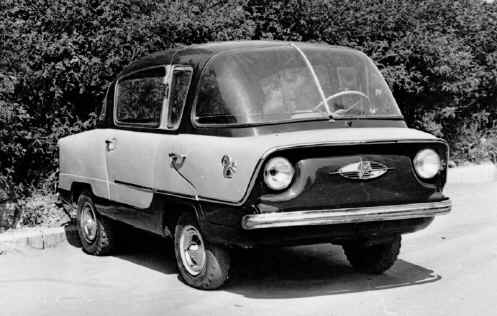
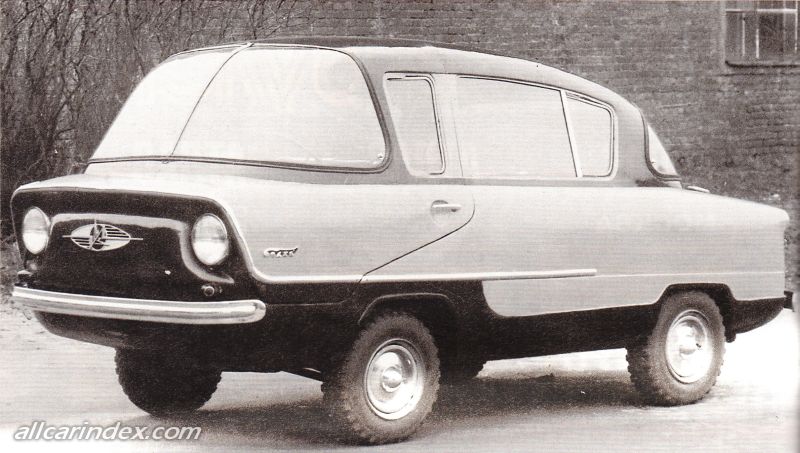
NAMI 050 Belka was a compact car project developed at NAMI beginning in 1955, originating from an idea by F.A. Reppikh, deputy chief designer at the Irbit Motorcycle Plant, who wanted a cheap car that plant could build. NAMI leadership backed the idea, and the project team included V.A. Aryamov, Yu.A. Dolmatovsky, K.V. Zeyvang, K.V. Korzinkin and A.E. Oksentievich, with the work led by Boris M. Fitterman, chief designer for passenger cars at NAMI.
The first prototype was completed in just six months, its body built in Irbit and the finished car brought to Moscow in mid-November 1955. It was named Belka, after the squirrel, since Irbit had been known before the revolution for its fur fairs. The designers summed up the concept in a "5x5" formula: five seats, 500 kg dry weight, a 0.5-liter engine, fuel consumption of 5 liters per 100 km, and a 500 km range on one tank.
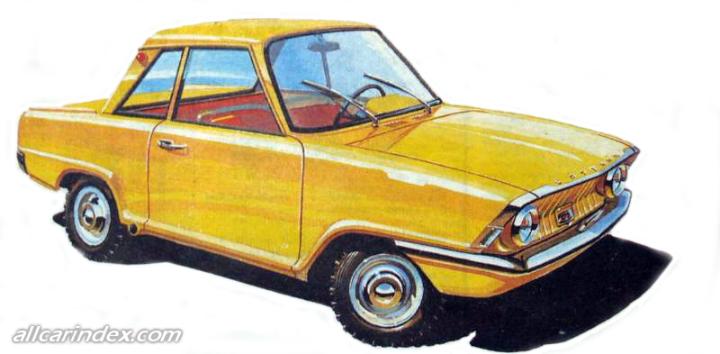
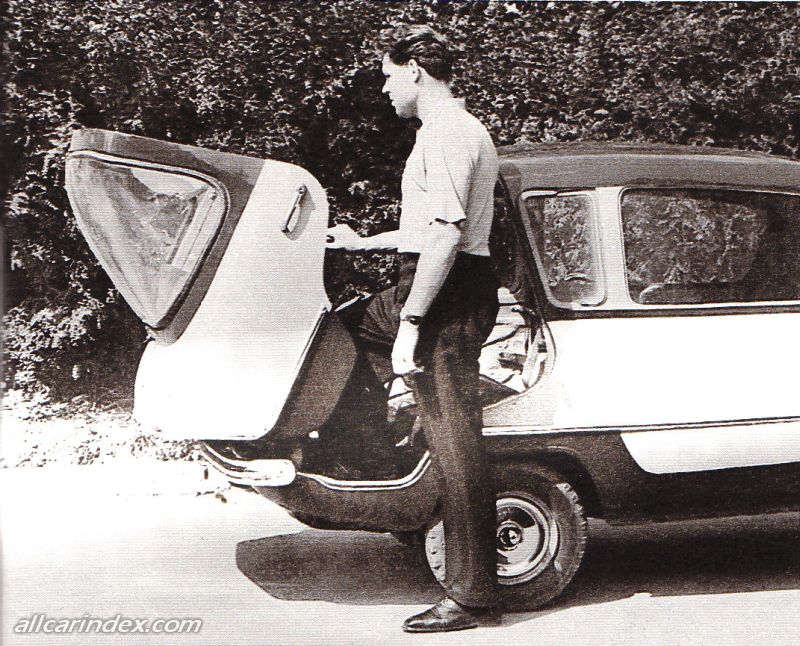
The car had a wagon-type layout with access to the front seat through an opening front panel, a design also used on the German BMW Isetta, BMW 600 and Zundapp Janus. It had fully independent suspension, split wheel rims, and motorcycle-type brakes fitted with hydraulic actuation. Besides the closed-body version, an open, doorless "agricultural" variant with a canvas top was also built, and two of the later examples used fiberglass body panels, a material NAMI was working with for the first time.
Belka was demonstrated at the highest levels of government, and in early 1957 the Council of Ministers of the USSR considered putting it into production at Irbit, as the press repeatedly reported. Production never began, however, largely because officials opted instead for the "proven" FIAT-600 design, which went on to form the basis of the ZAZ-965.
The car measured 3,324 mm long, 1,500 mm wide and 1,450 mm tall on a 1,570 mm wheelbase, with a rear-mounted engine driving the rear wheels in a four-seat body reaching 80 km/h. It used a two-cylinder opposed gasoline engine, either the IMZ-M72 (746 cc, 23 hp/16.9 kW at 4,700 rpm) or the MD-65 (648 cc, 17.5 hp/12.9 kW at 4,000 rpm), paired with a reworked three-speed manual gearbox from the Moskvich-401. Suspension was independent and spring-based front and rear, with hydraulic drum brakes, a 6-volt electrical system, and 5.00-10 tires.