
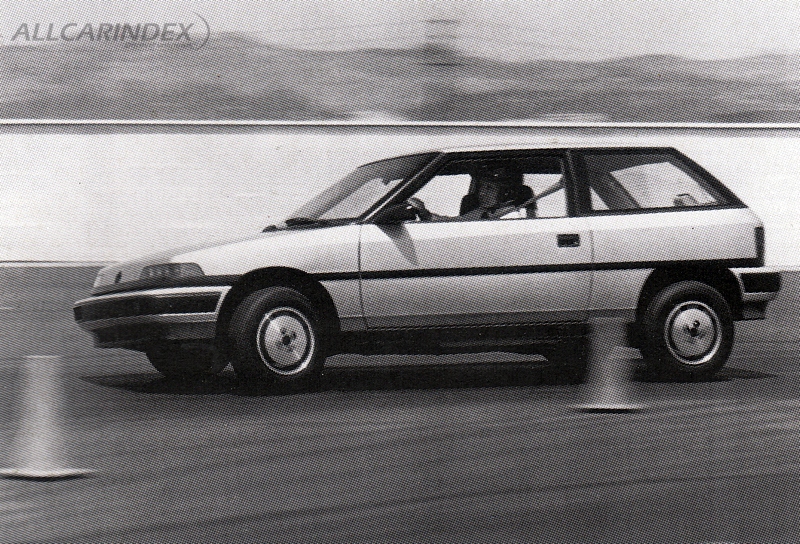
The Chrysler Liberty I was a concept car developed by Chrysler in the United States, presented by Chrysler chief Lee A. Iacocca in Anaheim, California, in May 1985 as the first roadworthy prototype of the Liberty project, which had begun in the spring of 1983. It took the form of a European-style fastback hatchback with three doors, built with an aerodynamically efficient body.
The project was intended to explore more rational and economical mass-production methods, part of Chrysler's effort, alongside General Motors' parallel work, to develop a particularly cost-efficient large-volume car. Iacocca stated that staying at the forefront of technology and new development in passenger and commercial vehicles was essential, with a goal of improving quality while cutting a car's costs by 2000 dollars. Chrysler invited the autoworkers' union UAW to participate in the program, which also involved the company's Advanced Development Group and its combined Design, Engineering, Purchasing and Manufacturing division, along with more than 40 suppliers. The Liberty project was in its second phase at the time of the Anaheim presentation, within a development process that normally spanned four to five years.
The Liberty I incorporated features Chrysler hoped could reach production by the end of the 1980s, including small-format headlights, purpose-designed instruments and safety devices, partial modular construction, and composite materials. Chrysler indicated it could be powered by either three- or four-cylinder engines. While General Motors' comparable Saturn project reached production in 1990, no further development of the Chrysler Liberty was subsequently reported.