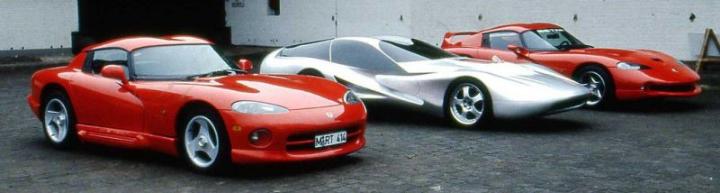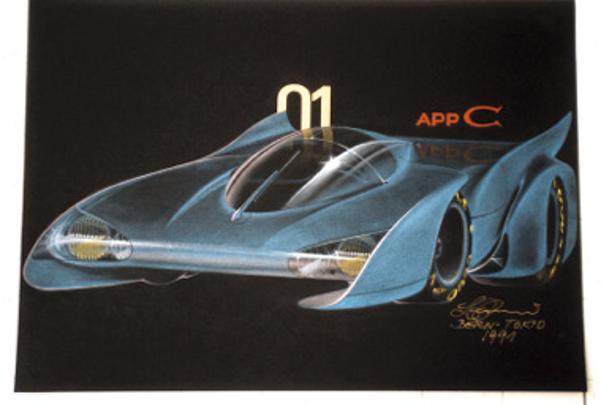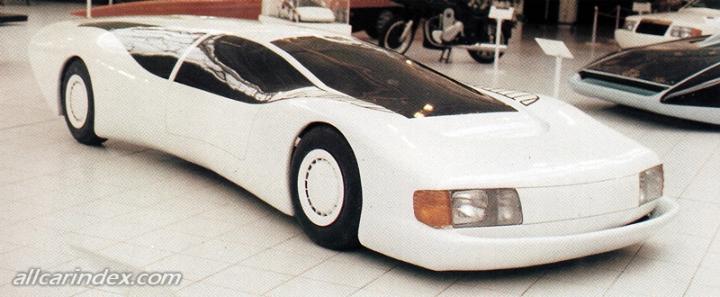



The Corvette Prototype Racer was a mid-engined, C-shaped record and show coupe built by German-born designer Luigi Colani at his CDB (Colani Design Bern) studio, which opened in 1986. It was conceived for a planned record-attempt expedition to the Bonneville Salt Flats in Utah. The car's bodywork applied Colani's "C-Form", a shape based on a patent granted to him by the German patent office in November 1967 for a downforce-generating aerodynamic form using staggered, inverted wing profiles. This split-wing principle was used at both the front and rear of the car to combine low drag with high downforce.
Power was intended to come from a Chevrolet Corvette V8 engine reworked in the Swiss canton of Bern, fitted with four-valve DOHC cylinder heads while retaining only its original engine block. With turbo assistance, output was briefly projected at up to 1200 hp from 5850 cc of displacement. This engine was never realized, and the C-Form car did not take part in the Utah test runs held in autumn 1989. A redesigned version, called the "Super-Vette", was shown at the special exhibition of the 1991 Geneva Motor Show with a front-mounted Corvette V8, which was later meant to be replaced by a heavily modified Chevrolet small-block mid-engine for the Utah attempt. The goal remained to beat the 432.7 km/h speed record set in 1938 by Rudolf Caracciola in a streamlined Mercedes-Benz. Colani also planned a ten-unit small series of this car, as had been intended for the earlier C-Form coupe.
The car was a two-door, two-seat streamlined high-performance coupe with a plastic body, built on a modified Chevrolet Corvette platform converted to a mid-engine layout. It measured 510 by 203 by 125 cm and weighed 1400 kg.