
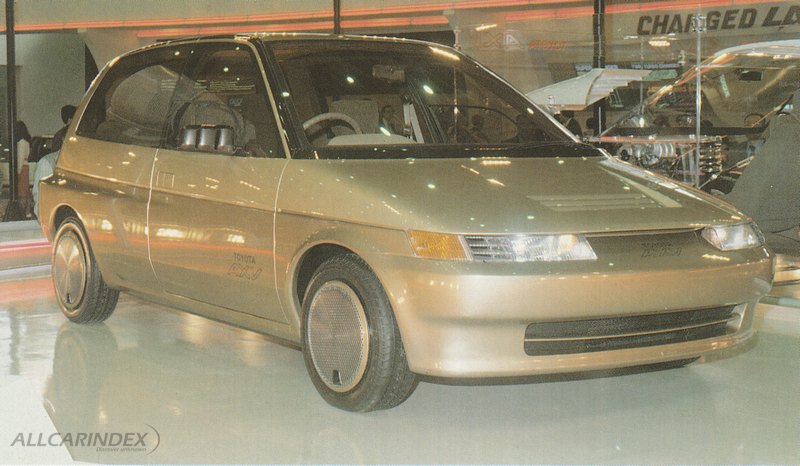
The Toyota AXV was a concept car described as an experimental family car of the near future, developed with fuel economy as its primary objective. It was a compact-class vehicle seating four adults, built using plastics and, in places, new composite materials, and it achieved a drag coefficient of 0.26 through wind-tunnel development. Toyota stated fuel consumption figures of 1.85 litres of diesel per 100 km at a steady 60 km/h, 2.4 litres per 100 km at 90 km/h, and an average of just under 3 litres per 100 km.
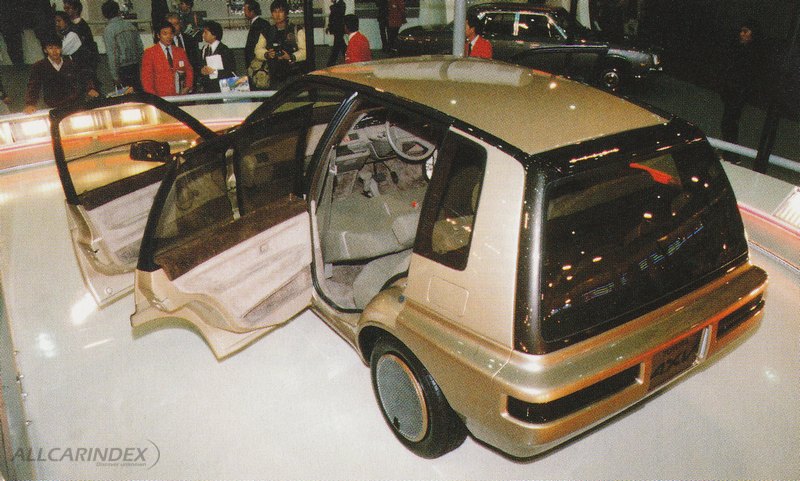
The body used a teardrop-shaped floor plan with its widest point set well forward, flush-fitting window glass that only partly opened at the bottom of the doors, and cooling air ducted out near the front of the hood. The door mirrors incorporated slots to reduce drag, the wheels wore smooth, finely perforated covers, and the underbody was flat and raised at the rear. The car had only three side doors, two of them on the left to suit Japanese left-hand traffic, which helped cut weight. Overall weight came to 650 kg, achieved through systematic substitution of lighter materials and reduced part dimensions throughout the body and mechanical components. The body panels included glass-fibre-reinforced plastic, with a one-piece hood made using the SMC (Sheet Molding Compound) process, and a roof formed from a steel-sheet laminate with a plastic interlayer for both weight saving and noise absorption. Side and rear windows were polycarbonate with a heat-reflective coating, and the headlamps used polycarbonate lenses with magnesium-alloy reflectors.
The engine was a 1.1-litre three-cylinder turbodiesel with direct injection, displacing 1084 cc and producing 56 hp at 4800 rpm and 101 Nm at 2600 rpm, equivalent to 50 hp per litre. It used a new electromagnetic-valve injection pump and a relatively small turbocharger for responsiveness at low revs, and was largely electronically controlled. Drive went through a continuously variable transmission derived from the Variomatic first used by the Dutch Daf brand in 1958, though the AXV's version used link chains rather than a belt; CVT transmissions of this type would not reach production until the Subaru Justy and Fiat Uno in 1987. Separate electronic control units for engine and transmission exchanged data to calculate the power needed under acceleration and to manage engine speed, injection and gear ratio for minimum consumption, though this electronic management could be switched off to allow stronger acceleration and engine braking.
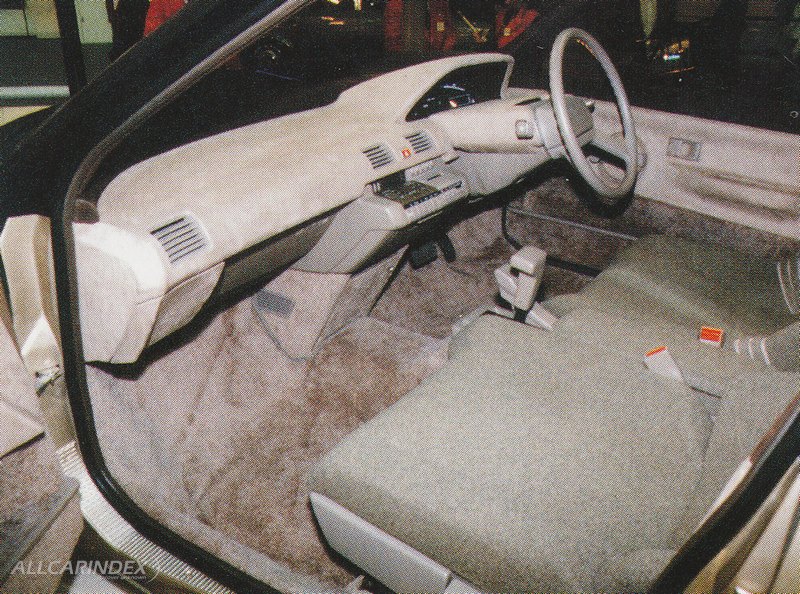
Additional weight- and noise-reduction measures included electronically controlled engine mounts, a two-piece oil pan combining plastic and laminated steel, ceramic-fibre piston material, a lighter oil filter, magnetic-core alternator, starter and fan motors, a lightweight battery, a plastic fuel tank, SMC rear suspension arms, and SMC wheel discs. The steering wheel was glass-fibre-reinforced plastic with a urethane covering and tilted upward for easier entry. The AXV measured 3765 mm long, 1640 mm wide and 1360 mm high, with a 2340 mm wheelbase and front/rear tracks of 1425/1380 mm.